Ein Multi-Agenten-n8n-System, das täglich SEO-Artikel schreibt und veröffentlicht
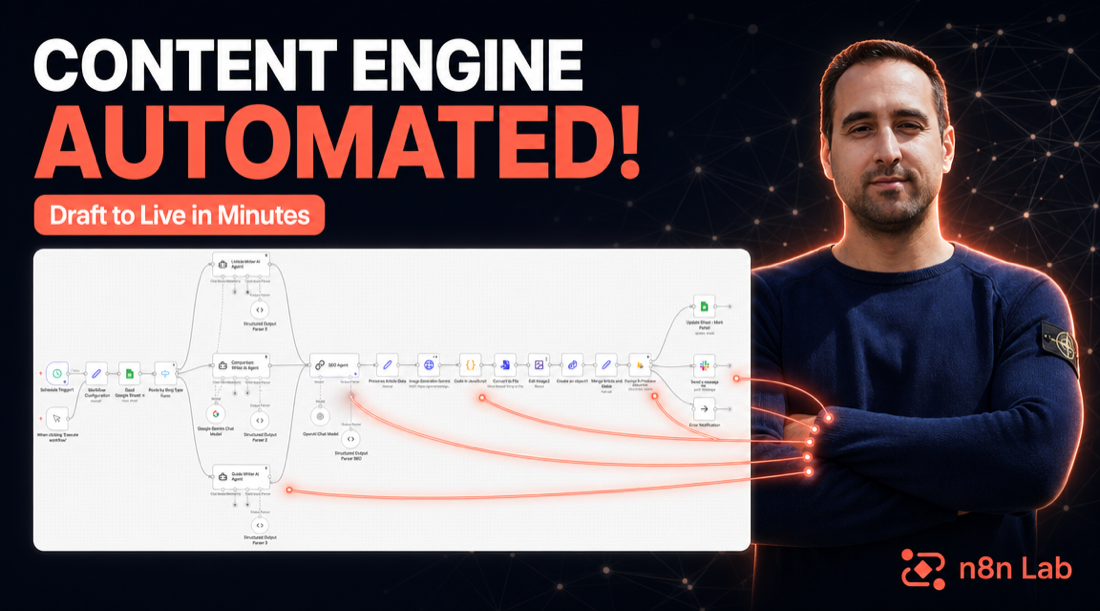
Wir haben eine Content-Engine mit fünf Agenten gebaut, die Briefings aus einer Tabelle übernimmt, SEO-fertige Artikel erzeugt, Cover-Art erstellt, auf der Live-Seite veröffentlicht und das Ergebnis automatisch meldet, ganz ohne menschlichen Eingriff nach dem Briefing.
120
articles published
fully automated daily output
812K
Google impressions
6 months of growth
5,000+
website visits
generated from the system
2,400%
click growth
from a standing start
Hintergrund
Der Engpass war die Produktion, nicht die Ideen
n8n Lab betreibt eine content-getriebene Wachstumsstrategie, und dem Team fehlte es nicht an recherchierten Themen. Die Herausforderung war, die Veröffentlichung schnell genug zu machen, um mit dem Backlog Schritt zu halten.
Blog articles drive organic search traffic, build topical authority in the n8n automation space, and create inbound interest from technical buyers at growth-stage companies. The backlog already existed, but turning a topic into a polished article was still a manual production task.
At four to six hours per article, a backlog of 978 topics would have taken years to clear by hand. The real goal was not to make the process a little faster. It was to eliminate the production layer entirely.
Die Herausforderung
Der alte Prozess ließ sich nicht auf tägliches Publishing skalieren
Wir brauchten Volumen, Konsistenz und niedrige Latenz beim Publishing, ohne den Blog in eine manuelle Operations-Queue zu verwandeln.
- The team already had nearly 1,000 researched topics in a spreadsheet, but writing, optimizing, and publishing each article manually still took 4-6 hours.
- Without a system, article structure, SEO formatting, and brand voice could drift over time, especially when different drafts were handled at different points.
- A completed draft that sat in review for two days delayed the whole pipeline and made the backlog harder to clear every week.
- The goal was to make a title brief the only manual input, then have a production-ready, SEO-optimized article appear automatically on the site.
The core ask was simple: take a title and brief, then publish a production-ready article automatically every day.
Walkthrough
Den Workflow in Bewegung sehen
Diese Demonstration zeigt, wie das System vom Themen-Queue zum veröffentlichten Artikel wechselt, mit dem gleichen Fünf-Agenten-Muster wie in der Fallstudie.
Die Lösung
Ein Fünf-Agenten-n8n-Workflow bringt ein Thema von der Tabelle zum veröffentlichten Beitrag
Nur die Recherche und das Briefing bleiben menschlich. Alles danach übernimmt der Workflow.
- 1
A schedule trigger fires daily and reads the Google Sheets topic queue.
- 2
A Switch node routes the topic to the right writing agent: Listicle, Comparison, or Guide.
- 3
The assigned writer agent produces a complete HTML article as a structured JSON object.
- 4
The SEO Agent reviews slug, meta title, meta description, tags, and keyword placement without changing the article length.
- 5
The Image Generation agent uses Gemini to create a custom cover image, then uploads it to Firebase Storage.
- 6
The article data and image URL are written directly to Firebase Firestore and published to the live website.
- 7
Slack announces the live URL and the sheet row is marked as done.
- 8
A LinkedIn post is generated from the published article and stored in the sheet for scheduling.
- Writer agents handle Listicle, Comparison, and Guide content types with separate prompts and length targets.
- The SEO Agent reviews slugs, meta fields, tags, and keyword placement without changing the article structure or length.
- The Image Generation agent uses Gemini to create custom cover art and uploads it to Firebase Storage.
- Retry logic and self-hosted n8n keep the whole pipeline resilient and cost-stable as volume scales.
Impact
Das System hat organisches Wachstum mit steigender Wirkung freigesetzt
Die Ergebnisse wurden direkt in Google Search Console und Atomic AGI gemessen, plus einem separaten Blick auf AI-getriebenen Traffic.
| Metric | Result | Change |
|---|---|---|
| Total Clicks | 4,250 | +2,400% |
| Total Impressions | 812,560 | +15,339% |
| Average Position | 9.71 | -65.3% (improved) |
| Articles Published | 120 | — |
4,250
Total clicks
A 2,400% increase from the starting point.
812,560
Total impressions
Strong visibility growth across six months.
750
AI-sourced clicks
Referrals from ChatGPT, Claude, Perplexity, and Gemini.
120
Articles published
Fully unattended after the brief.
| Source | AI Clicks | Conversions | Avg. Time on Site |
|---|---|---|---|
| ChatGPT | 445 | 4 | 3:02 |
| Claude | 155 | 1 | 8:21 |
| Perplexity | 136 | 1 | 2:56 |
| Gemini | 13 | 0 | 2:20 |
| Total | 750 | 6 | 3:13 |
Technische Details
Die Architektur bleibt modular, resilient und leicht erweiterbar
Jeder Teil des Workflows hat genau eine Aufgabe, dadurch bleibt die Wartung beherrschbar, während die Content-Engine wächst.
- Listicle, Comparison, and Guide agents each use a distinct prompt and structure, while sharing the same Gemini model and structured output parser for reliable JSON output.
- SEO rules live in one review step, so the writers stay focused on content while the SEO agent enforces slug formatting, metadata length, and internal linking opportunities.
- Writer and image generation calls are retried up to five times with wait intervals, which helps the pipeline keep moving when a model or tool has a transient failure.
- Because the system is self-hosted, the cost stays predictable even as the article volume grows and the pipeline runs every day.
Nächste Schritte
Die nächste Phase macht das System noch vorausschauender
Sobald die Kern-Publishing-Engine steht, geht es darum, die Signalqualität zu verbessern und den Wert jedes Artikels zu erhöhen.
Expand the scoring model with upsell and expansion intent so the system can catch more revenue opportunities.
Add Slack alerts for high-value thresholds so humans can react instantly when needed.
A/B test the LinkedIn and email-friendly outputs against the article trigger type to sharpen performance over time.
The brief is the only manual input. After that, the workflow handles writing, SEO, image generation, publishing, and distribution on its own.
Die nächste Content-Engine bauen
Soll dein Content-Backlog zu einer täglichen Publishing-Maschine werden?
Wir können das Briefing, die Writer-Agenten, SEO-Prüfungen, Bilderzeugung und die Veröffentlichung so gestalten, dass sich dein Team auf Ideen statt auf Produktion konzentriert.
 n8n Lab
Wir helfen dir, die Automatisierungslandschaft von morgen zu gewinnen
Eliminiere manuelle Engpässe mit individueller n8n-Automatisierung. Wir entwerfen das System für dich.




Unser Team
Bereit zu helfen