A Multi-Agent n8n System That Writes and Publishes SEO Articles Daily
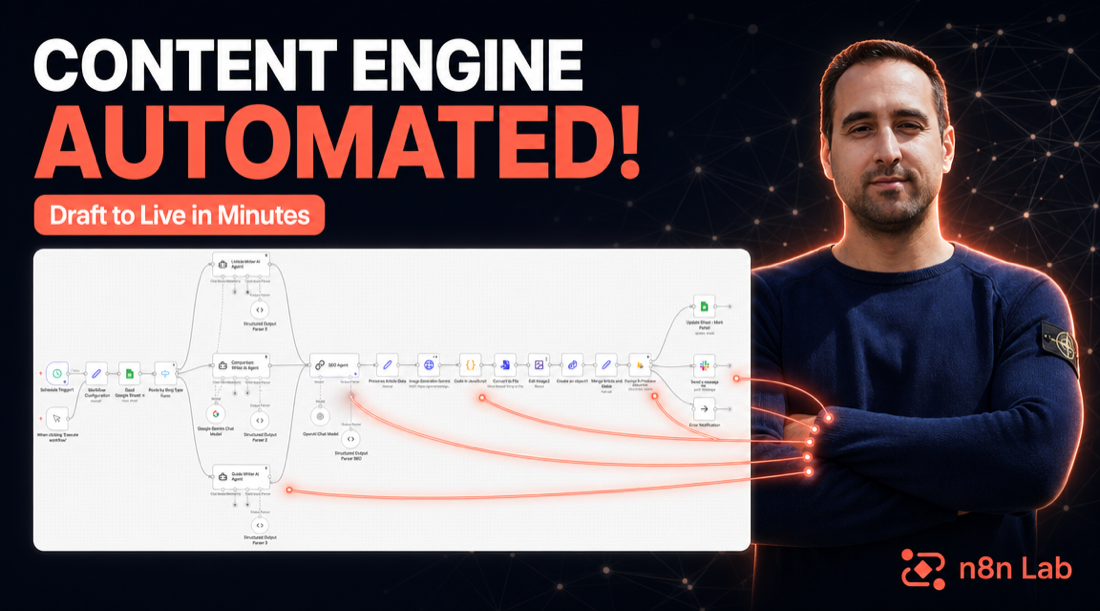
We built a five-agent content engine that takes a brief from a spreadsheet, generates SEO-ready articles, creates cover art, publishes to the live site, and announces the result automatically, with no human involvement after the brief.
120
articles published
fully automated daily output
812K
Google impressions
6 months of growth
5,000+
website visits
generated from the system
2,400%
click growth
from a standing start
Background
The bottleneck was production, not ideas
n8n Lab runs a content-led growth strategy, and the team had no shortage of researched topics. The challenge was making publication fast enough to keep up with the backlog.
Blog articles drive organic search traffic, build topical authority in the n8n automation space, and create inbound interest from technical buyers at growth-stage companies. The backlog already existed, but turning a topic into a polished article was still a manual production task.
At four to six hours per article, a backlog of 978 topics would have taken years to clear by hand. The real goal was not to make the process a little faster. It was to eliminate the production layer entirely.
The Challenge
The old process could not scale to a daily publishing cadence
We needed volume, consistency, and low-latency publishing without turning the blog into a manual operations queue.
- The team already had nearly 1,000 researched topics in a spreadsheet, but writing, optimizing, and publishing each article manually still took 4-6 hours.
- Without a system, article structure, SEO formatting, and brand voice could drift over time, especially when different drafts were handled at different points.
- A completed draft that sat in review for two days delayed the whole pipeline and made the backlog harder to clear every week.
- The goal was to make a title brief the only manual input, then have a production-ready, SEO-optimized article appear automatically on the site.
The core ask was simple: take a title and brief, then publish a production-ready article automatically every day.
Walkthrough
See the workflow in motion
This walkthrough shows the system moving from topic queue to published article using the same five-agent pattern described in the case study.
The Solution
A five-agent n8n workflow takes a topic from spreadsheet to published post
Only the content research and briefing stays human. Everything after that is handled by the workflow.
- 1
A schedule trigger fires daily and reads the Google Sheets topic queue.
- 2
A Switch node routes the topic to the right writing agent: Listicle, Comparison, or Guide.
- 3
The assigned writer agent produces a complete HTML article as a structured JSON object.
- 4
The SEO Agent reviews slug, meta title, meta description, tags, and keyword placement without changing the article length.
- 5
The Image Generation agent uses Gemini to create a custom cover image, then uploads it to Firebase Storage.
- 6
The article data and image URL are written directly to Firebase Firestore and published to the live website.
- 7
Slack announces the live URL and the sheet row is marked as done.
- 8
A LinkedIn post is generated from the published article and stored in the sheet for scheduling.
- Writer agents handle Listicle, Comparison, and Guide content types with separate prompts and length targets.
- The SEO Agent reviews slugs, meta fields, tags, and keyword placement without changing the article structure or length.
- The Image Generation agent uses Gemini to create custom cover art and uploads it to Firebase Storage.
- Retry logic and self-hosted n8n keep the whole pipeline resilient and cost-stable as volume scales.
Impact
The system unlocked compounding organic growth
The results were measured directly in Google Search Console and Atomic AGI, with a separate read on AI-sourced traffic.
| Metric | Result | Change |
|---|---|---|
| Total Clicks | 4,250 | +2,400% |
| Total Impressions | 812,560 | +15,339% |
| Average Position | 9.71 | -65.3% (improved) |
| Articles Published | 120 | — |
4,250
Total clicks
A 2,400% increase from the starting point.
812,560
Total impressions
Strong visibility growth across six months.
750
AI-sourced clicks
Referrals from ChatGPT, Claude, Perplexity, and Gemini.
120
Articles published
Fully unattended after the brief.
| Source | AI Clicks | Conversions | Avg. Time on Site |
|---|---|---|---|
| ChatGPT | 445 | 4 | 3:02 |
| Claude | 155 | 1 | 8:21 |
| Perplexity | 136 | 1 | 2:56 |
| Gemini | 13 | 0 | 2:20 |
| Total | 750 | 6 | 3:13 |
Technical Details
The architecture stays modular, resilient, and easy to extend
Each piece of the workflow is responsible for one job, which keeps maintenance manageable as the content engine grows.
- Listicle, Comparison, and Guide agents each use a distinct prompt and structure, while sharing the same Gemini model and structured output parser for reliable JSON output.
- SEO rules live in one review step, so the writers stay focused on content while the SEO agent enforces slug formatting, metadata length, and internal linking opportunities.
- Writer and image generation calls are retried up to five times with wait intervals, which helps the pipeline keep moving when a model or tool has a transient failure.
- Because the system is self-hosted, the cost stays predictable even as the article volume grows and the pipeline runs every day.
Next Steps
The next phase is to make the system even more predictive
Once the core publishing engine is in place, the roadmap is about improving signal quality and increasing the value of each article.
Expand the scoring model with upsell and expansion intent so the system can catch more revenue opportunities.
Add Slack alerts for high-value thresholds so humans can react instantly when needed.
A/B test the LinkedIn and email-friendly outputs against the article trigger type to sharpen performance over time.
The brief is the only manual input. After that, the workflow handles writing, SEO, image generation, publishing, and distribution on its own.
Build the next content engine
Want your content backlog to turn into a daily publishing machine?
We can design the brief intake, writing agents, SEO checks, image generation, and publication flow so your team focuses on ideas instead of production.
 n8n Lab
Let Us Help You Win Tomorrow's Automation Landscape
Start eliminating manual bottlenecks with custom n8n automation. Let us architect the system for you.




Our Team
Ready to help