n8n Agents vs Workflows: When to Use Which
Agents and workflows are not competitors. Use a workflow when you already know the steps. Use an agent when the task has no fixed steps. Here is the framework we use to decide, and it is the same one we use to build production n8n systems for clients.















The short answer
Three rules that cover most n8n builds. Everything else on this page is the detail behind them.
If you can draw the process on the canvas, build it as a deterministic workflow. It runs the same way every time, it is cheap, and anyone opening the canvas can see exactly what happens.
Keep the process in the workflow and bring AI in for one defined job: classify, extract, score, draft, fill a field. The AI is a step, not the driver.
When the next step depends on the last answer, there is no sequence to draw. Give an agent objectives, tools and guardrails, then let it work out the path.
The three ways AI automation runs in n8n
They are not tiers of maturity. They are three tools, and the strongest systems use all three.
Fixed logic, fixed order, fixed output. Fast, cheap and reliable, and it stays readable months later.
Example
A lead arrives, the workflow enriches it, scores it and routes it to the right owner. Same result on run ten thousand.
Most of the process stays pure logic, and the model is called only where judgement is genuinely needed, with a defined input and a defined output.
Example
An inbox triage workflow where a model classifies the message and extracts the fields, and deterministic nodes decide what happens next.
A first-class entity in n8n with instructions, tools, skills, memory and channels. It decides which tool to use and in what order.
Example
A marketing assistant with Notion and Miro as tools, reachable in Slack, that answers asks and updates work without a predefined path.
n8n agents vs workflows: the cheat sheet
If you only remember one table from this page, make it this one.
Deterministic workflow
Workflow with AI steps
n8n Agent
Best for
Deterministic workflow:Repeatable processes where the sequence is already known
Workflow with AI steps:Mostly fixed processes that need one AI judgement inside them
n8n Agent:Open-ended tasks where the steps cannot be defined in advance
Who decides the steps
Deterministic workflow:You decide. Every branch is on the canvas
Workflow with AI steps:You define the process, the model decides inside one step
n8n Agent:The agent decides at runtime, within the limits you set
Predictability
Deterministic workflow:Identical output on every run
Workflow with AI steps:Predictable path, variable output inside the AI step
n8n Agent:Variable path, so guardrails and review matter
Running cost
Deterministic workflow:Lowest, no model tokens at all
Workflow with AI steps:Low, one or two model calls per execution
n8n Agent:Highest, several model and tool calls per task
Build effort
Deterministic workflow:Fast to build, trivial to audit
Workflow with AI steps:Medium, each AI step needs a clear contract
n8n Agent:Fast to start, prompts and tools need iteration
Oversight
Deterministic workflow:Full, every path is visible before it runs
Workflow with AI steps:Approvals attach to a specific step
n8n Agent:Tool allowlists, human-in-the-loop and session review
What this looks like inside n8n
Agents are not a separate world. They sit on the same canvas as your workflows.
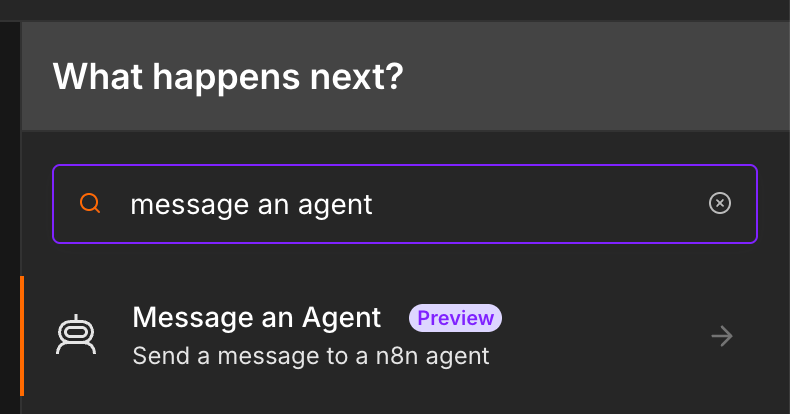
Message an Agent: a workflow can hand a step to an agent and keep the rest of the process deterministic. Screenshot: n8n.
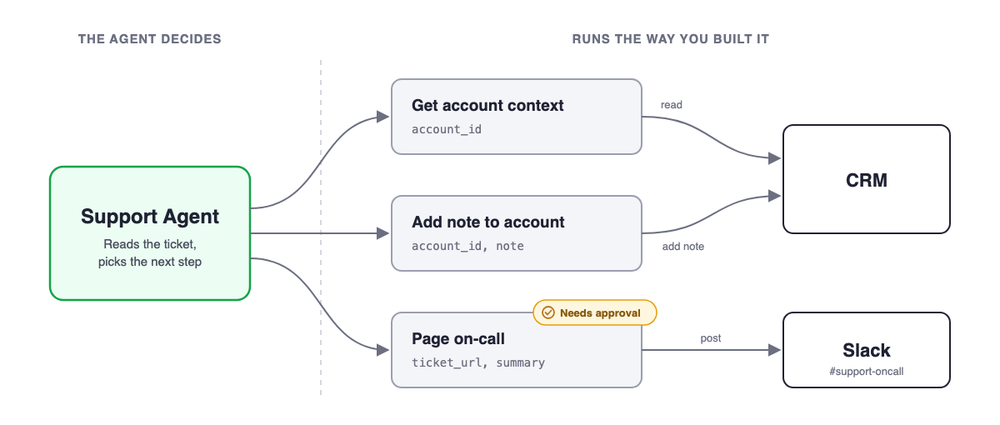
The agent decides the next action, the workflow runs exactly the way you built it. Diagram: n8n.
The 4-minute explanation from the n8n team
Liam from n8n walks through the difference between credentials, workflows and the new Agents tab, and where each one fits.
How agents and workflows work together
The two directions matter more than the comparison. This is where most of the value is.
Any workflow with the right trigger can be exposed to an agent as a single capability. The agent chooses when to run it, but the workflow still does exactly what you built, with the parameters you allow. That is how you give an agent reach without giving it raw API access.
The new agents live on the canvas, so a workflow can call one when a step genuinely needs autonomy, then continue with deterministic logic. You get agent judgement in one place and predictable execution everywhere else.
Five questions that decide it
Run any process through these and the answer is usually obvious. If it is not, we can answer it on a call.
Can you draw the steps in advance?
Answer:Then build a workflow. If you cannot draw it, you are describing an agent.
Must the same input always produce the same output?
Answer:Then keep it deterministic. If one specific step is fuzzy, add an AI step and keep the rest fixed.
Does the next step depend on the answer to the last one?
Answer:That is a conversation, not a sequence. That is an agent with memory and sessions.
Could a wrong action be expensive or irreversible?
Answer:Put the action in a workflow behind an approval, and let the agent prepare it instead of performing it.
Does the input look different every single time?
Answer:Then you want an agent, with its tools limited to the systems it is actually allowed to touch.
We build specialised n8n agent implementations
n8n Lab designs, builds and ships agents and workflows on your own n8n instance, so the automation lives in your infrastructure and not in a black box.
Agent design and build
Objectives, instructions, skills, tools, knowledge, memory and channels, configured for one job and tested against your real inputs.
Workflow-as-tool architecture
We turn the automations you already own into safe, parameterised tools, so the agent gets reach without ever holding raw API credentials.
Guardrails and human-in-the-loop
Tool allowlists, approval checkpoints on sensitive actions, and session review so you can see every step the agent took and what it called.
What you get
- A decision map of your processes: workflow, AI step or agent, with the reasoning written down
- One production agent or workflow built and tested on your own n8n instance
- Your existing workflows exposed as controlled agent tools
- Approval points, tool limits and monitoring on everything that touches a real system
- Documentation and training so your team can extend it without us
n8n agents vs workflows: FAQ
The questions we get asked most often about the new Agents tab.
Keep reading
The deeper breakdown, the build service, and a live agent demo.
Why Choose n8n Lab as Your AI Automation Agency
We're strategic automation partners, not just implementers. Every n8n workflow we build is architected for measurable ROI, long-term scalability, and competitive advantage.
As certified n8n experts, we've delivered hundreds of successful, high-complexity projects across dozens of industries.
We don't use templates. Every n8n workflow implementation delivered on time, on budget, with documented ROI.
Our agile, streamlined development process means you see a tangible return on your investment in weeks, not months.
 n8n Lab
Let Us Help You Win Tomorrow's Automation Landscape
Start eliminating manual bottlenecks with custom n8n automation. Let us architect the system for you.




Our Team
Ready to help