The takeaway
n8n agents and workflows are two layers of one system, not two competing products. Existing workflows become agent tools, agents can be called from inside workflows, and the AI Agent node still works. The new discipline is deciding, per process, which layer owns the work.
Why it matters for builders
For teams already running n8n: existing workflows do not need rebuilding, they become controlled tools an agent can call, which is the cheapest path to autonomy without exposing raw API credentials. The cost that changes is model spend, because an agent makes several model and tool calls per task where a deterministic workflow makes none. The design discipline that changes is oversight: workflows are auditable by structure, agents require tool allowlists, approval checkpoints on write actions, and session review.
n8n shipped Agents as a first-class concept in September 2026, and it quietly settles an argument that has been running in automation teams for two years: agents or workflows?
The answer n8n is now shipping is "both, and they call each other." Agents sit at the top level of the product next to credentials and workflows, they are the place where the AI has the most freedom, and every existing workflow becomes something an agent can use as a tool.
What n8n actually launched
The new Agents tab is a packaged entity, not a workflow with a chat node bolted on. Each agent carries a model, plain-language instructions, channels and triggers (Slack, Telegram, Linear, Discord, a schedule), tools, reusable skills, optional sub-agents, uploaded knowledge files, memory that can persist across sessions, and a session log that records every step, every tool call, and the input and output of each call.
Two details matter more than the feature list. The existing AI Agent node is unchanged, so nothing built in the last two years breaks. And the new agents live on the same canvas, which means the choice between agent and workflow is no longer a fork in the road.

The three modes, not two
n8n's own explainer (four minutes, worth watching) frames automation as three modes rather than two camps:
- Deterministic workflows. No AI. Fixed logic, fixed order, fixed output, cheap and auditable.
- Workflows with AI steps. Semi-deterministic: the process stays logic and the model is called for one defined job such as classification or extraction.
- Agents. Their own entity, closer to a coworker, deciding which tool to use and in what order, with autonomy limited by tool restrictions and human approval.
The practical difference is where judgement lives. In a workflow the AI has a defined step with a defined contract. In an agent, the steps only emerge at runtime.
Workflows are the agent's toolkit
The part with the most commercial consequence is that any workflow with the right trigger can be used by an agent as a tool. A support agent, for example, can be given three capabilities: pull account context, add a note to the account, page on-call. The agent decides which one to use; the workflows enforce exactly what is possible.
That is how enterprises can adopt autonomy without handing a model raw API credentials. The deterministic core stays deterministic, and the agent only chooses when to run it.
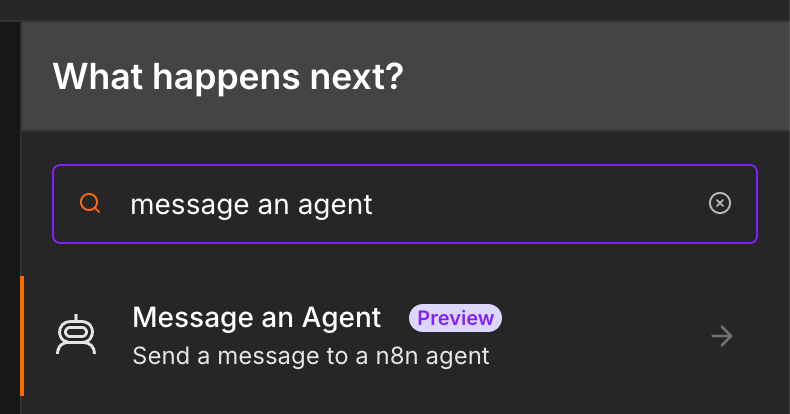
It also runs in reverse. Agents are available on the canvas, so a workflow can hand one step to an agent and keep the rest of the process fixed. The new Message an Agent node is the mechanism.
What it costs to run an agent
An agent behaves like a coworker, and it consumes tokens like one. A single task can trigger several model calls and several tool calls where a deterministic workflow makes none. The sensible architecture is to place expensive autonomy only where it earns its keep and push everything repetitive into workflows the agent calls.
The same logic applies to control. A workflow's oversight is structural, because every branch is visible on the canvas before it runs. An agent's oversight has to be designed: tool allowlists, approval checkpoints on actions that touch real systems, and session review.
Availability
Agents are included in both n8n Cloud and self-hosted instances. On n8n Cloud the Agents tab is rolling out in phases, so keeping an instance on the latest version is what makes it appear. Self-hosted users enable it from their instance settings.
Why this matters for builders
For two years the honest advice to teams was "you can build an agent in n8n, but you will assemble it yourself." That advice is now stale. What replaces it is a design decision that has a correct answer per process: deterministic workflow, workflow with one AI step, or agent.
Teams that treat that as a real decision will ship autonomy where it earns its keep and logic everywhere else. Teams that do not will pay model costs to reimplement rules they already knew.
Key takeaway: n8n agents and workflows are two layers of one system, not two competing products. Existing workflows become agent tools, agents can be called from inside workflows, and the AI Agent node still works. The new discipline is deciding, per process, which layer owns the work.
Want a decision map for your own processes? See how n8n Lab builds specialised n8n agents or book a free 30-minute audit.
The Automation Brief
Read 5 AI stories instead of 50.
The essential moves in AI agents, models, automation and infrastructure — filtered for builders and operators, with the part that actually matters.
No noise. Unsubscribe anytime.
Editorial notes
Stefan Trbojevic
n8n Lab Editorial
12 October 2026
12 October 2026
Sources
AI disclosure: AI assisted with research and drafting. Factual claims are reviewed by an editor.